
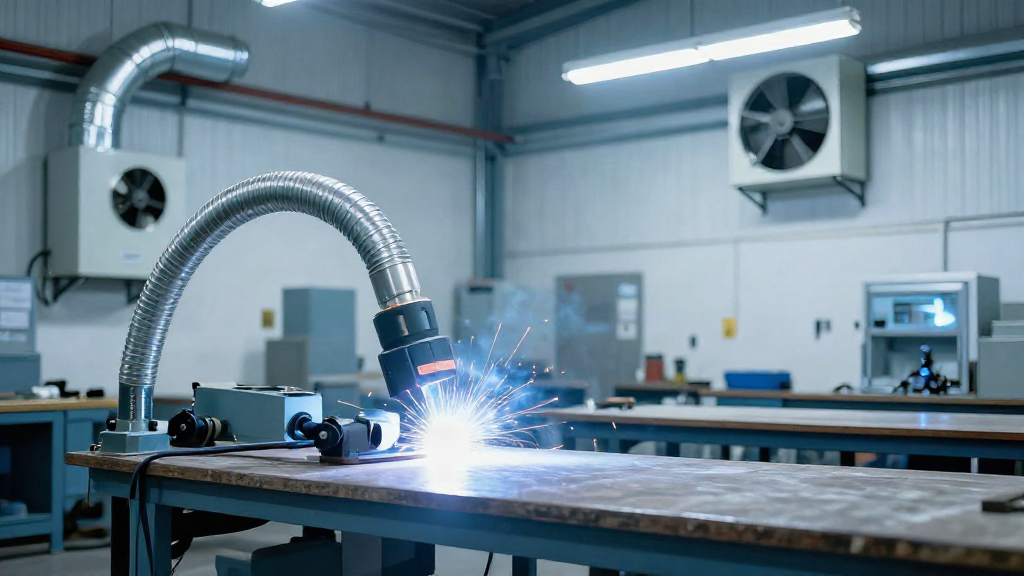
It's a Tuesday morning at a small fabrication shop off Kirkstall Road. The welder has been working through a stack of steel frames since seven, and by ten o'clock there's a faint blue haze hanging under the roof lights. Nobody is coughing yet, but the air tells its own story.
The extraction arm above that bench is the reason the haze isn't worse - and it only does its job properly if someone checks it.
If you run a workshop in Leeds, that check has a name: LEV testing. It's one of those jobs that's easy to put off and hard to ignore once you understand it, so here's what local businesses actually need to know, without the jargon.
What Is LEV Testing?
LEV stands for local exhaust ventilation. It's the engineering control that captures dust, fume, vapour or mist at the point it's created, before it can reach your lungs.
Depending on your trade, that might be a fume extraction arm over a welding bay, a downdraught bench in a garage, a ducted canopy above a spray booth, or a dust collector hooked up to a spindle moulder.
These systems matter because the hazards they control are serious.
Welding fume is linked to respiratory disease and, in some cases, cancer.
Wood dust is a known cause of asthma and nasal cancer.
Fine metal dust from grinding and polishing carries its own risks, and solvent vapour from paints and degreasers can affect the nervous system.
All of this sits under the umbrella of COSHH - the Control of Substances Hazardous to Health Regulations.
LEV testing, or LEV inspection, is the routine examination and test of that equipment to prove it's still capturing and removing contaminants effectively. That last point matters. An extraction arm can look perfectly fine from the shop floor and still be working poorly, because most of the failure happens inside ductwork and filters where you can't see it.
Legal Requirements Under COSHH
Regulation 9, employers must make sure that any control measure provided to protect against exposure to hazardous substances - including LEV - is maintained in efficient working order and in good repair.
In practice, that means thorough examination and testing at regular intervals. For most LEV systems, HSE guidance sets that interval at 14 months.
The figure isn't arbitrary: it gives you a month's grace over a yearly cycle, so you don't slip past the legal deadline if a visit gets delayed. A small number of systems need testing more often - some processes call for an examination every six months - so it's worth confirming what applies to yours.
The duty sits with you as the employer. You need to keep records of every examination and test, make them available to the enforcing authority on request, and act on any faults an inspection identifies. If a system fails its test, you can't simply note it and carry on.
Depending on the risk, you may need to take it out of use or put other controls in place while it's repaired.
Who Needs Testing?
If your processes release airborne contaminants and you rely on extraction to control them, you almost certainly need testing.
Around Leeds that includes:
Fabrication and welding shops, from small two-bay units in Morley to larger engineering works
Garage and bodyshop operations, including downdraught benches and spray booths
Joinery and woodworking businesses turning out doors, windows and fitted furniture
Engineering firms using grinding, polishing, shot blasting or metal finishing
Paint, coatings and solvent-using operations
West Yorkshire has a dense manufacturing base, and businesses in Bradford, Wakefield and Pudsey face exactly the same duty as those in the city centre. Size doesn't exempt you, either. A three-person joinery in Pudsey carries the same legal obligation as a large plant - the difference is only in how much equipment needs testing.
What Happens During an Inspection?
An LEV inspection is a structured, hands-on process rather than a quick glance at the ducting. It typically covers:
A visual check of the whole system
hoods, ductwork, filters, fans and discharge points
looking for damage, corrosion, blockages or signs of poor capture
Measurement of airflow and pressure at key points, to confirm the system is moving the volume of air it was designed to
A check that contaminants are being captured and carried away correctly, and that extracted air isn't being recirculated back into the workplace unless that's been proven safe
A check of filter condition, and whether any monitoring devices or indicators are working
A check of the discharge point, so you're not simply moving the problem outside and creating a nuisance
Afterwards you should receive a report: what was tested, the readings taken, whether the system passed, and any defects or actions required. Keep that report. It's your evidence that you're meeting your COSHH duty, and it's the first thing an inspector will ask for.
Costs
It isn't possible to give a single figure, because the price depends on the job. An inspector pricing LEV testing will weigh up:
How many systems, hoods or extraction points you have
The type and complexity of the LEV, from a single portable unit to a large ducted installation
How accessible the ductwork and discharge points are
Whether filters, monitoring or extra measurements are involved
Travel and scheduling, and whether you book a single visit or an annual programme Rather than guess, ask for quotes.
The sensible approach is to get like-for-like pricing for the same scope of work, so you can compare fairly. Comparing a few providers also means you can check they're properly qualified and can explain what they'll test in plain terms.
FAQs
How often does my LEV system need testing?
For most systems, every 14 months, following HSE guidance. Some processes - including certain welding and wood dust operations - need more frequent testing, sometimes every six months. If you're unsure, ask a competent tester what applies to your specific system.
Can I carry out LEV testing in-house?
You can handle the routine daily and weekly checks - looking for damage, blockages or obvious airflow loss. But the thorough examination and test under COSHH needs a competent person with the right instruments and the ability to interpret the results. That's usually an independent specialist.
What happens if my system fails its test?
You'll get a report flagging the faults. Fix them promptly and, depending on the risk, you may need to stop using the system or the process until it's put right. Failing a test isn't a crisis if you act on it - what matters is that you can show you responded.
Getting Your LEV Testing Sorted
If you run a business in Leeds, Bradford, Wakefield or anywhere across West Yorkshire and you use extraction to control dust, fume or vapour, your testing date is a legal deadline, not a nice-to-have. It's also an opportunity: a system that's working properly protects your team and often saves money on wasted energy and unnecessary filter changes.
If you're not sure who to call, LEVInspections.co.uk helps you find independent LEV inspection providers who can carry out the work. You describe what needs testing, compare the options that come back, and choose who you want to work with. No technical exam, no obligation - and you stay in control of the decision.